Showing posts with label artists. Show all posts

Friday, July 6, 2012

Alexander Calder Flamingo "Travel Edition"

This is a very clever idea by designer Victor Fong - a travelling edition of Calder's monumental sculpture "Flamingo"   Be sure to check out his website for more images.

Victor Fong - Designs

Design by Victor Fong

Sunday, May 13, 2012

Jennifer Steinkamp


This is an excerpt of a talk given by Jennifer Steinkamp at Otis College.  I became aware of Jennifer's work after seeing the beautiful tree projection that she did for the Cleveland Clinic.

Monday, June 13, 2011

The John and Yoko of Modern Art


Today marks the 76th birthday of one of the great artists of our time, Christo Vladimirov Javacheff - more commonly known as "Christo".

I first became aware of Christo back in the late 70's after seeing the wonderful documentary "Running Fence" by the Maysles brothers. If you have no idea who Christo is, I suggest that you begin with this film because it really gives you a sense of what his work is all about.  A Christo piece is usually a temporary installation such as a fence, banner, or drape constructed on top of a particular structure or landscape. The sculpture seeks to interact with its environment by hiding certain features while highlighting others, and dynamically changing in response to changes in  environmental conditions. Often, these sculptures are quite expansive in size and require careful engineering to be produced.


For example, Running Fence was an 18 foot-high fence constructed of white nylon fabric supported by cables and steel posts that followed 25 miles of hills and valleys in Northern California on its way to the Pacific Ocean.  From a distance, the fence caught the rays of the sun throughout the day creating a beautiful ribbon of light running along the contours of the landscape.  But the physical sculpture itself, as beautiful as it was, was only one element of the piece.  When you watch the documentary, you begin to understand that Christo is really using his art to engage with the public in the broadest possible way; from early concept, through funding and regulatory approvals, design, construction by volunteers, maintenance, and disassembly, you learn that his work is all about how people interact with art and the artist.  And when you watch Christo get up in front of an audience of ranchers, city officials, and concerned citizens to defend his project, it is impossible not to fall in love with his energy, sincerity, and dynamic personality.  And he looks like an artist should look.


photo by Wolfgang Volz

And if that is not enough to make you love Christo, then I will point out that his relationship with Jeanne-Claude, his wife, is one of the greatest love stories in modern art. Born on the exact same day in different countries, they met at the age of 23 when Christo left Bulgaria to live in Paris as a refugee.  They met and fell in love, but Jeanne-Claude was engaged to another and her parents did not approve of Christo and insisted that the marriage plans be carried out.  They probably did not know that she was already pregnant with Christo's child on the day of the wedding.  After only one week, Jeanne-Claude left her new husband and fled back to Christo, never to leave his side until the day she died in 2009.  Working as a team, they created some of the most unique, dramatic, and inspirational art of the 20th century.   


photo by Andy Carvin via Flickr

Wednesday, June 8, 2011

Thinking Tool


Olafur Eliasson: "Thinking Tool", 2010. 
Mirror, sunglasses (2 halves/complementary colors). 

Friday, March 25, 2011

MODEL A’LA EXPERIMENT

Here's a video of an interesting architectural model created by Rasmus Svingel, produced while he was a student at the Aarhaus School of Architecture in Denmark.


Experiment process model from Rasmus Svingel on Vimeo.

Rasmus describes it as "an investigation of space and program diversity through movement".  The concept for the model was originally created in a digital computer program and then "processed into an analog model".  Rasmus explains that the model is his attempt to study how a structure might adapt to changing needs necessitated by climate, space, etc.

My first impression was an appreciation for the design and beauty of the model, as it resembles some mobile ideas that I have been working on.  When I opened the video to see more, I was delighted to find that it is in fact a beautiful kinetic sculpture - using a series of carbon fibre wires and rubber bands to produce movement.

Be sure to check out more of Rasmus' designs in his online portfolio.  He has some wonderful ideas, and if his career in architecture doesn't work out, I would suggest that he would have a bright future as an artist...a career transition that happens more often than you would expect.

Rasmus Svingel online portfolio

Wednesday, February 2, 2011

Dan Grayber

Dan Grayber's sculptures look like something you would find in a mechanical engineering lab at some university, or perhaps in an R&D department at Caterpillar, Inc. The abundance of springs, cables, chains, pulleys, thread forms and structural beams painted in yellow makes them highly interesting to look at.  All of them use the physics of compression, tension, leverage and friction to provide mechanisms for the self-sufficient support of each sculpture within its environment. You'll find them wedged inside glass domes, clinging to corners, and stuck into vertical walls. 

I really love how these sculptures first captivate you with their mix of complex beauty and industrial workmanship, and then puzzle you as you try to figure out how all of the pieces function together to make it work.  The punch line comes when you begin to wonder what would happen if a cable or a spring failed, or a rubber pad slipped, and all of the potential energy in the piece was suddenly liberated.  I had to chuckle over one comment that Dan made about one of his sculptures having some "issues with gravity"

Good stuff.  Be sure to check out Dan's website for more....


Wednesday, December 15, 2010

Robert B. Howard

"Multiple Compass" - Robert B. Howard                        Photo by Ian Reeves
I really like this mobile by Robert Boardman Howard (1896 - 1983).  This article describes the propeller-like sculpture as being black, with dark blue blotches painted on it, suggesting the markings on military aircraft.

Here is another one of his sculptures at the San Francisco MOMA:

This sculpture is entitled "Ram".  The photo does not convey the mammoth size of this sculpture, which is listed in the SFMOMA website as being 117 inches (nearly 10 feet) tall!  It appears that the three-legged geometric shape is free to rotate on the bulbous black base.

Here is another sculpture in wood, also at the SFMOMA, which I like the best of the three.  It is called "Semaphore".

photo by Marsi - via Flickr

Here is a picture that I found of a party in his studio.  You can see some interesting mobiles and stabiles.  Hey, that guy on drums looks like Bobby Kennedy!


I've tried to find more information about this artist via the Internet without much success.  Wikipedia mentions his name as being one of the Coit Tower muralists from the California School of Fine Arts.  Since there is also a painting in the holdings at the SFMOMA I suspect this is the same artist.  I also found this memorial on the Internet but it appears to be about another artist with the same name - his birth/death dates do not match the dates listed in SFMOMA and there is no mention of Coit Tower or any involvement with San Francisco.

Do you know anything about Robert B. Howard?   Leave a comment if you do!

Sunday, September 26, 2010

Innovators vs. Imitators

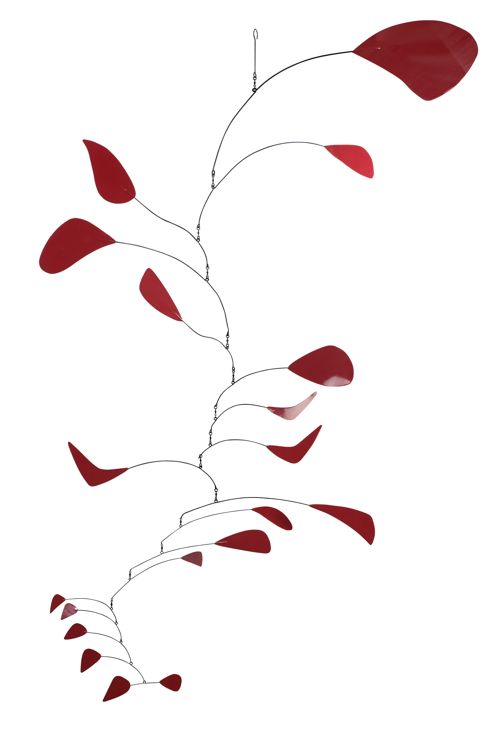
Hanging mobile artists face a fundamental question: will they be creating mobiles that are just essentially derivations of previous work done by Alexander Calder, or will they try to create something unique and strive to push the medium in a new direction? 

Once an artist has learned the process and techniques necessary for creating a hanging mobile, it really is a fairly simple matter to reproduce a Calder-style piece by using variations of his distinctive shapes and painting them in solid primary colors.  It's easy, it's fun, and clients love it...after all, for most of them, the image of a hanging mobile is defined by the work they have seen by Alexander Calder.

Some of my most popular designs are Calder-style mobiles and stabiles:

"Satori" hanging mobile by Unigami

"Aquilla" hanging mobile by Unigami

"La Mer Digne" hanging mobile by Unigami

If you make a quick search on the Internet you will find many, in fact most, hanging mobile artists are producing mobiles in the Calder tradition.

"Modernist" - Julie Frith
"Big Red" - Dave Vande Vusse
"Jet Set" by Debra Ann
Ebay mobile by unknown artist

As you can see, some of these are very creative and beautiful, and others are less successful.

There is a tipping point I think, when when this type of work becomes so derivative that (at best) it may be more accurately described as a "craft" rather than fine art.  That is not what I want to do. I strive to create unique designs that capture the spirit of Calder, but yet reflect a particular style that I have been developing over the years. I think that my mobiles "Angler", "Questron", and "Orbit" among others, represent the style that I am trying to acheive; something clean, dynamic, and modern looking.  I don't think these look anything like Calder mobiles, but they are close cousins...they are beautiful, they are unique, but they probably are not going to get me a review in American Artist.


"Angler" - hanging mobile by Unigami
"Questron" hanging mobile by Unigami

"Orbit" hanging mobile by Unigami

A few artists have succesfully advanced this form of kinetic sculpture in bold new directions, most notably George Rickey, who began making mobiles very similar to the work of Alexander Calder but eventually branched off into large outdoor geometric inspired sculptures:

"Three Squares Gyratory" - George Rickey

Tim Prentice is one of my favorite artists.  He notes in his artist's statement that he intends to "concentrate on the movement of the piece rather than the object".  He has devised some interesting methods to create walls and ribbons of elements that undulate in the breeze.  I really love his "Zinger" mobile:

Ned Kahn is GOD.  You really have to visit his website and watch the videos to really appreacite how amazing his work is. Using the power of physical science, he has created kinetic sculptures that explore the effects of movement in wind, water, sand, fog, fire, and light.  

"Wind Portal" - Ned Kahn


These are just a few examples of some amazing work by some amazing artists.  I am always inspired and excited when I discover someone working in a new direction.  Leave a comment below and let me know who you like!


Saturday, September 4, 2010

Hans Kooi

Hans Kooi is a Dutch artist who creates kinetic sculptures using wood, stone and magnetism. I really love the minimalist, zen-like, quality of his sculptures.